


Silicone radiator coolant hose are widely used in vehicles and industrial machinery. They are used to transfer the coolant from one component to another and help maintain the engine temperature. But the routing path is not always the same for every vehicle. That’s why manufacturers design them in different shapes to exactly fit the path.
In today’s article we will discuss the various shapes of silicone radiator hose and their features. Understanding these shapes can help you to select the right silicone radiator coolant hose for your application.
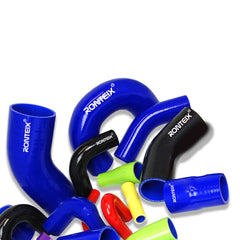
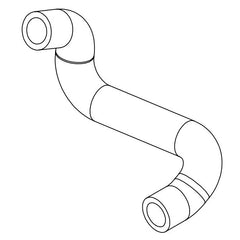
Silicone Radiator Coolant Hoses By Shape
Following are the different shapes of silicone radiator coolant hose. Each has its own different features or characteristics which you can choose according to your need.
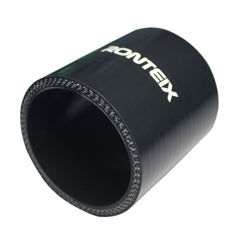
1. Straight Silicone Hose
Straight hose is the simplest form of silicone hose. You can use it as a coupler to connect two rigid pipes in a straight path without any curve or bend. It is heat resistant and a multi pile hose made up of polyester or aramid. You can choose this linear hose for coolant, turbo boost and air intake system. They mostly handle temperatures from -50℃ to 250℃ and pressure from 4 bar to 12 bar (0.4 MPa to 1.2 MPa). You will find its standard length almost 76mm to 102 mm which may be 3 inches to 4 inches. Its inner diameter commonly ranges from 6mm to 102mm (1 / 4 inch to 4 inches) to fit the pipe size.
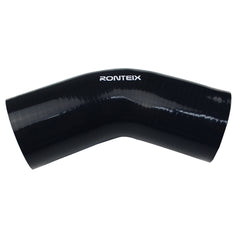
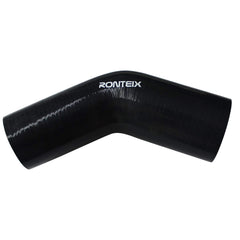
2. Silicone 45 Degree Elbow
It is a strong, flexible and 3-4 multi-layered fabric tubular pipe. These are gently bent up to 45 degrees to join the two aluminium or steel pipes. You can utilize them in the turbocharger system and as a bridge between engine water outlet to radiator neck. Because they have the ability to manage high heat, change the direction of fluid and vibrations safely.
It can tolerate the heat up to -50℃ to +180℃ and working pressure from 3 to 5 bar or burst pressure up to 15 bar (0.3 MPa to 1.5 MPa). You will notice its length from 100mm to 150mm (4 to 6 inches) and its internal diameter is 13mm to 203mm (0.5 to 8 inches).
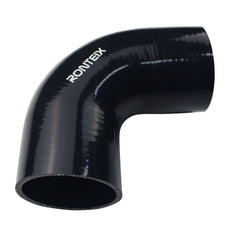
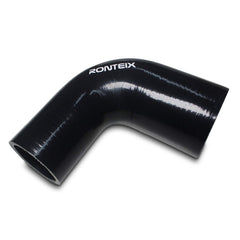
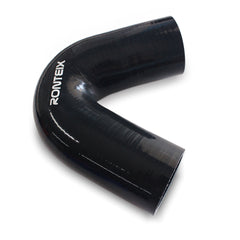
3. 90 Degree Elbow Silicone Hose
This elbow hose is a curved, L shaped flexible tube constructed from layers of silicone and fabric reinforcement. You can apply it to the turbocharger piping, intercooler system, radiator coolant lines and heavy duty industrial intake system. You can select them to redirect the fluid or air flow in tight space to absorb engine vibration and reduce joint stress.
This right angle elbow hose can withstand the temperature -50℃ to 350℃, pressure limit 0.3 bar to 5 bar and burst compression 10-15 bar (0.03 MPa to 0.5 MPa). If we talk about its inside diameter which is 6mm to 100mm (0.25-4 inches) and length almost 100 to 150mm (4 to 6 inches).
4. 135 Degree Silicone Hose
It is a type of elbow hose which is a pre-formed, bendable duct at an obtuse angle of 135 degree. These consist of high strength silicone and fabric piles like polyester and aramid. You can use these elbow pipes to divert air movement, coolant and turbo gases around obstacles in a high heat engine without collapsing the hose.
You can install it in heavy machinery such as marine engines and agriculture equipment. They can control thermal intensity ranging from -50℃ to +250℃ and pressure 3.0 to 10.0 bar (0.3 to 1.0 MPa) while rupture stress 10 to 30 bar. In addition, its inner width is 6mm to 102mm (0.25-4 inches) and its length range is 102 mm to 152mm (4-6 inches).
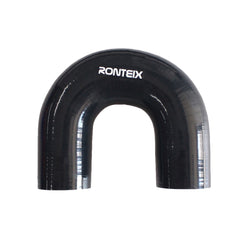
5. Silicone Hose 180 Degree
A 180 degree silicone hose is another important type of elbow hose that has a U shape tube. You can fix these half circle hoses in industrial machines, turbo and cooling systems. It contains three to four strengthening layers of polyether or kevlar plus transfers the liquid and gas to other routes in narrow spaces.
They can manage heat level up to -50℃ to 250℃ and tension level is 3 bar to 10 bar(0.3 MPa to 1.0 MPa) maximum limit is 20 bar. Furthermore, its interior size ranges from 6mm to 102mm (1 / 4 to 4 inches) and elongation from 100mm to 150mm (3-6 inches).
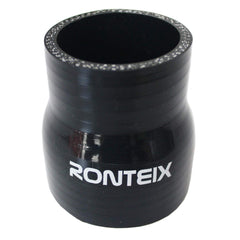
6. Silicone Reducer Hose
Silicone reducer hose is a cone shaped or stepped changeable tube which has unequal diameter from large to small end. It connects the two pipes of different sizes while maintaining the smooth, leak free flow of air, coolant and water. You can use them in marine engines, join radiator hoses, turbo and intercooler pipes.
You will notice that silicone reducer hoses are available in various angles such as 0°, 45°and 90°. If we tell you its thermal state which is -50℃ to 250℃ and compression level is 3 to 12 bar (0.3 MPa to 1.2 MPa) which can be increased. These are 75mm to 100mm (3-4 inches) wide and 76mm to 102mm (3-4 inches) long. You must avoid using them for oil and fuel.
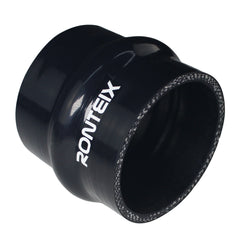
7. Silicone Hump Hoses
These are specialized, flexible hoses that have multiple supporting layers and raised hump-like sections in the middle. It attaches the two pipes in a high oscillation environment by absorbing thermal expansion, rocking engine movement and slight misalignment without cracking or disconnecting.
For turbocharger systems, intercooler piping, air intakes and heavy duty radiator cooling lines, you can use it. They have the capacity to bear the temperature up to -50℃ to 220℃ and load 2.8 bar to 5.5 bar with burst pressure 16 bar. It has 25mm to 102mm (1 to 4.5 inches) internal diameter and 76mm to 102mm (3 to 4 inches) extension.
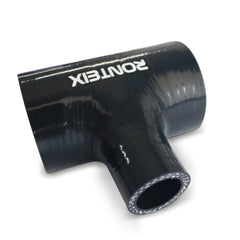
8. T shape Silicone Hose
This T shape silicone hose is a three way pipe connector built from flexible silicone, polymer or aramid layers. You can utilize these hoses to split or join the fluid and air lines. You can install them in coolant, radiator, turbo and intercooler systems.

It can handle extreme heat and cold from -50℃ to 220℃ and force 3 to 9 bars (0.3MPa to 0.9 MPa). Its inside width is 13mm to 102mm (0.5 to 4 inches) and length 76mm to 127mm (3-5 inches). Moreover, these silicone hoses are not suitable for fuel or oil transfer unless lined with fluorosilicone.
9. Silicone Y Hose
It is another three way tubular junction which looks like the letter “Y” constructed from reinforcement sheets. You may use this to isolate the one stream into two and merge two into one. It redirects the movement of liquid or air with minimum pressure and turbulence as compared to T junction at 30 to 45 degree angle.
You mostly use it in automotive cooling systems, turbo setups, marine plumbing and industrial machinery. These operate stably at -50℃ to 250℃ and stress 1 to 3 bars (0.1 MPa to 0.3 MPa) which may rise up to 20+ bar. Whereas, its inner diameter is 6mm to 102mm (0.25 inches to 4 inches) and length 100mm to 150mm (4 to 6 inches).
10. S shape Silicone Hose
These are dual bend elastomeric tubular channels that mimic the alphabet “S” and have 3- 4 fabric piles. It routes the fluid or around the tight engine component while handling severe shaking, thermal and pressure range without collapsing. You can apply them in vehicle radiator, coolant, air intake and turbo charger lines.
Now we come to its temperature which is -50℃ to 250℃ and working pressure 3 to 9 bar (0.3 MPa to 0.9 MPa) and maximum up to 15 bars. In addition, inside diameter 45mm to 80mm (1.77 inches to 3.15 inches) and distance from one end to other around 150mm (5.9 inches).
11. Z Shape Silicone Hose
Z shape silicone hose is a flexible, multi angle fabric reinforced tube. You will see that it has dual directional bend with a 90 degree angle at one end and 135 degree angle at other end. It is used to divert the coolant, water, and air around narrow machinery components to withstand the thermal expansion and mechanical shock.
These are safe for water, coolant and air but not suited for fuel and oil. They can tolerate temperature from -40℃ to 250℃ and tension 2 to 9 bar (0.2 MPa to 0.9 MPa) with burst pressure up to 20 bar. However, the internal diameter ranges 14mm to 38mm (1- 1 / 2 inches) and length about 150 mm (6 inches).
How To Choose the Right Silicone Hose Shape?
To choose the right silicone hose shape, you need to match the geometry to your pathway arrangement or route layout. For this purpose, you have to measure your path requirement accurately so that it does not collapse. You can use straight hose for direct lines, elbow hose such as 45°, 90°, 135° or 180° for sharp turns. Moreover, you can select reducers for joining two different pipe diameters and hump hoses to absorb vibration or slight misalignment. Before selection, you make sure that these provide enough space for clamping.
In addition, it meets the standard SAE J20 and is made up of polyester, Nomex and fiberglass fabric piles. You must check that it handles extreme temperature, working and burst pressure limit. The important thing is that it commonly carries liquid, coolant and air. But if you want to use it for petroleum products, it must be lined with fluorosilicone.
Conclusion
To sum it up, we can say that above-mentioned silicone hoses are ideal for coolant, water and air but they can swell or damage if they are in direct contact with fuel or oil. So, we cannot use them for petroleum products except fluorosilicon. They all are made up of polyester, aramid and other high quality reinforced fabric layers. These all fulfill the standard SAE J20 plus are also available in a variety of colors such as blue, black and red.
If you want to customize silicone radiators hose in different shapes and colors. In addition, you have further requirements, we are here to help you. You can contact us any time, we provide the best products at a cost effective price. For custom radiator coolant silicone hoses, please send your 3D format or CAD file to jackie@ronteix.com, we will respond ASAP.
FAQs
What Shape Hose Do I Need To Connect a Turbo to an Intercooler?
To connect the turbo to the intercooler, you need a straight coupler, hump hose or elbow hose based on your routing and alignment. If the pipe and turbo outlet are different in diameter, you can choose a reducer hose.
Do All Silicone Radiator Hoses Need Wire Reinforcement?
No, all silicone radiator hoses do not need wire reinforcement. Most standard preformed replacement silicone hose entirely rely on embedded fabric such as polyester or aramid. Because it handles the pressure and prevents swelling without any steel wire inside.
Why Are Shaped Silicone Hoses More Expensive than Straight Ones?
Shaped silicone hoses cost more than straight because you need custom metal mold for that, complex manual labour and extra steps during production. It also requires handfitting on the mold and special curing process. Whereas for straight silicone hoses, you can use a simple continuous machine extrusion method.


